
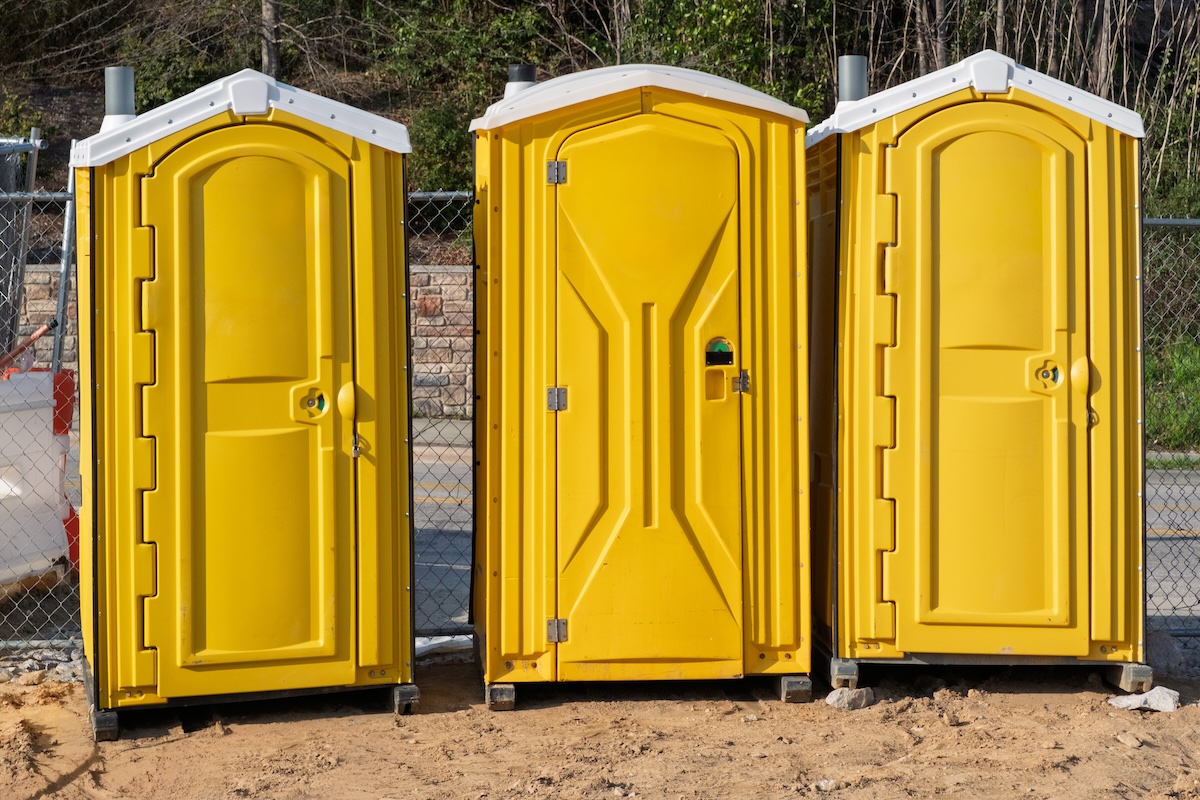
No one wins a construction contract by virtue of having the nicest portable restrooms on site. But any project manager who has run a crew without them knows what happens to productivity, morale, and client perception when workers are making the 5 minute walk to a gas station 3 times a day.
Portable toilets on a construction site are a practical decision with real consequences for how a job runs, how the workers feel about being there, and how clients and inspectors perceive the operation.
Today, we’re going to go over a lot of the things you should know about portable toilet rental for construction sites: the regulations that apply, how to calculate how many units you need, which types of units suit different site conditions, how to place them for maximum usability, and what proper servicing looks like in practice.
OSHA sanitation requirements for construction sites
Portable toilet rental on a construction site is not optional under federal law. OSHA’s sanitation standard for construction, found under 29 CFR 1926.51, sets out specific requirements for outdoor toilet facilities that apply to virtually every construction site with employees present.

The requirements cover more than simply having a unit somewhere on the property. OSHA specifies the ratio of toilets to workers, the condition those facilities must be kept in, and the proximity of handwashing facilities to restroom units. Failure to meet these requirements can result in citations and fines, and in the event of a worksite inspection or incident investigation, sanitation compliance is one of the areas that gets reviewed.
The practical takeaway is that portable toilets on a construction site are a compliance matter as much as a convenience one. Getting the number of units right is where that compliance starts.
Note on state regulations: OSHA sets the federal floor for sanitation requirements. Some states operate their own OSHA-approved programs with requirements that meet or exceed the federal standard. If you operate in a state with its own plan, such as California (Cal/OSHA) or Washington (L&I), check the applicable state standard in addition to the federal one.
How many portable toilets does your site need?
The number of units required under 29 CFR 1926.51(c)(1) is determined by the number of employees on the site. The table below reflects the federal minimums. Important: Always confirm exact current requirements directly from OSHA and/or any other relevant bodies before making any decisions.
| Number of employees on site | Minimum toilets required |
|---|---|
| 1 to 15 | 1 |
| 16 to 35 | 2 |
| 36 to 55 | 3 |
| 56 to 80 | 4 |
| 81 to 110 | 5 |
| 111 to 150 | 6 |
| Over 150 | 1 additional unit per 40 employees above 150 |
These are minimums, so they are worth thinking about as a floor rather than a target. A few factors can make the minimum insufficient in practice.
Peak crew periods are one. If your site typically has 20 workers but peaks at 40 during a framing or concrete pour phase, planning around the typical headcount means you will be under-equipped at exactly the moments when your crew is working hardest. Sizing up for peak periods avoids a compliance problem and a morale one at the same time.
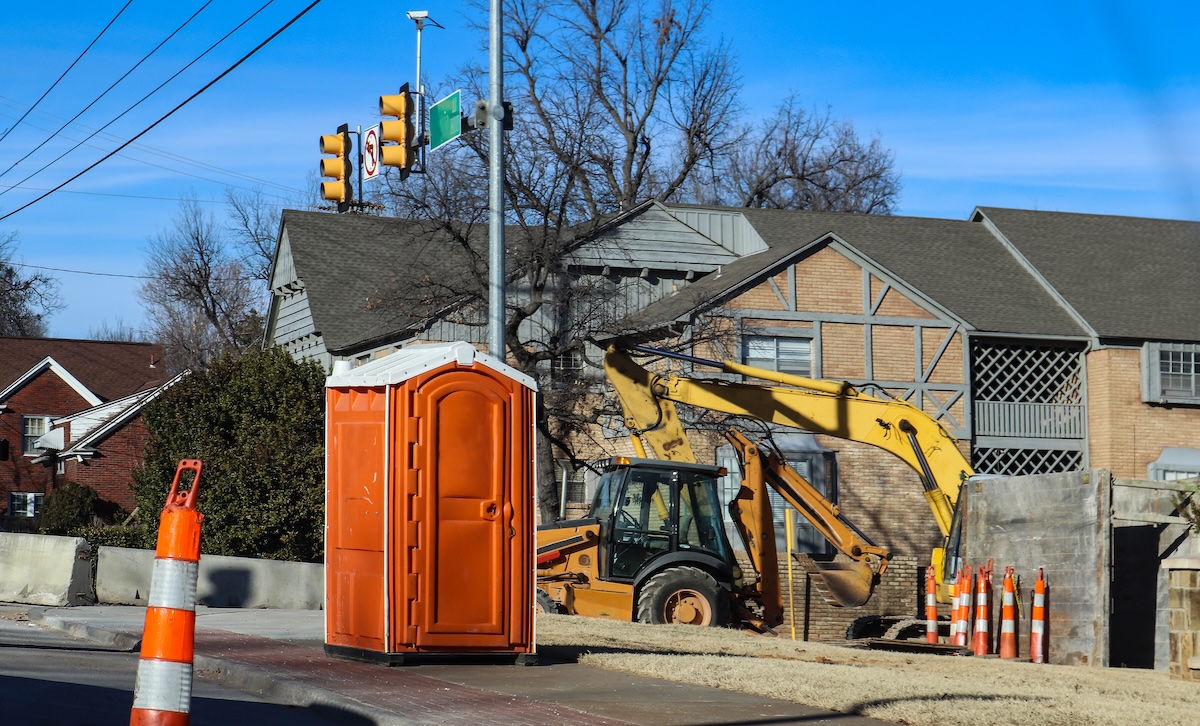
Site geography is another. A large site where workers are spread across a significant area may benefit from multiple units placed at different locations rather than one cluster of units at one end of the property. A worker who has to walk a quarter mile to reach the nearest toilet will either lose meaningful time or avoid the trip, neither of which serves anyone.
Finally, if the site will receive client visits, inspector walkthroughs, or any public access, a dedicated unit in a well-maintained area separate from the primary crew facilities is a worthwhile addition. More on that below.
Types of portable restroom units
Portable toilet is a broad term. Several distinct unit types exist, each suited to different site conditions, user needs, and budgets.
Standard portable toilet
The standard unit is what most people picture when they hear things like “porta-potty rental”: you typically have a self-contained plastic cabinet with a toilet seat, a waste tank below, and a hand sanitizer dispenser inside.
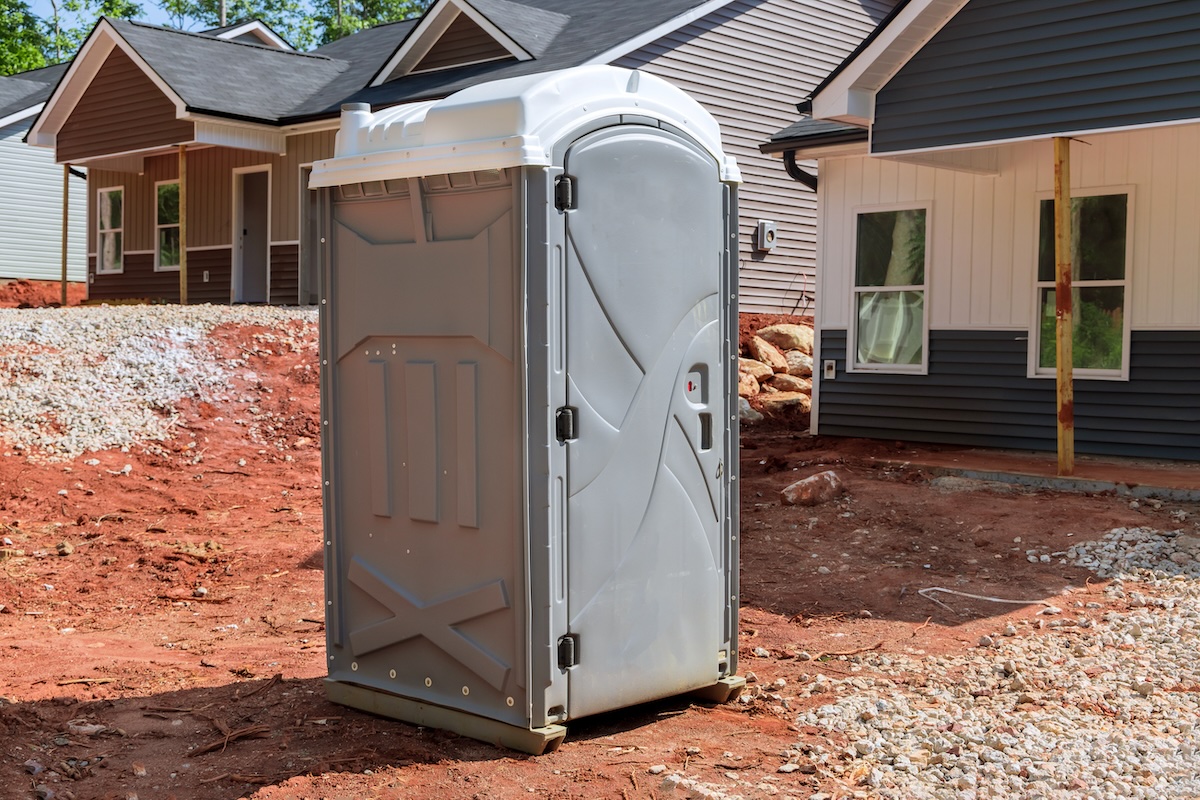
These can be easily delivered by truck, require no water hookup or electrical connection, and are serviced by a pump truck on whatever schedule is arranged with the rental company. For the majority of construction sites, the standard unit handles the job reliably.
ADA-accessible portable toilet
ADA-accessible units are wider than standard units and include interior grab bars, a lower toilet height, and enough floor space to accommodate a wheelchair. The Americans with Disabilities Act and related federal accessibility standards require accessible facilities on sites open to the public, and some state and local regulations extend that requirement to worksites with employees who have disabilities. When in doubt, including at least one accessible unit is both the compliant and practical choice.
These units are larger than standard, which affects placement decisions, particularly on tight urban sites. They also require the same pump-truck access for servicing as standard units.
Flushable portable toilet
Flushable units include a freshwater holding tank and a flushing mechanism, which uses a small volume of water and chemical solution to move waste into the holding tank below. The interior experience is closer to a conventional restroom. These units are used on sites where client visibility or extended project duration makes a higher-comfort option worth the additional rental cost. They require the same pump-truck servicing as standard units, though the freshwater tank also needs to be refilled during service.
Restroom trailer
Restroom trailer rentals are towable units that typically include multiple stalls, running water, interior lighting, and in some configurations, climate control. They require a water connection and electrical hookup to operate at full function.
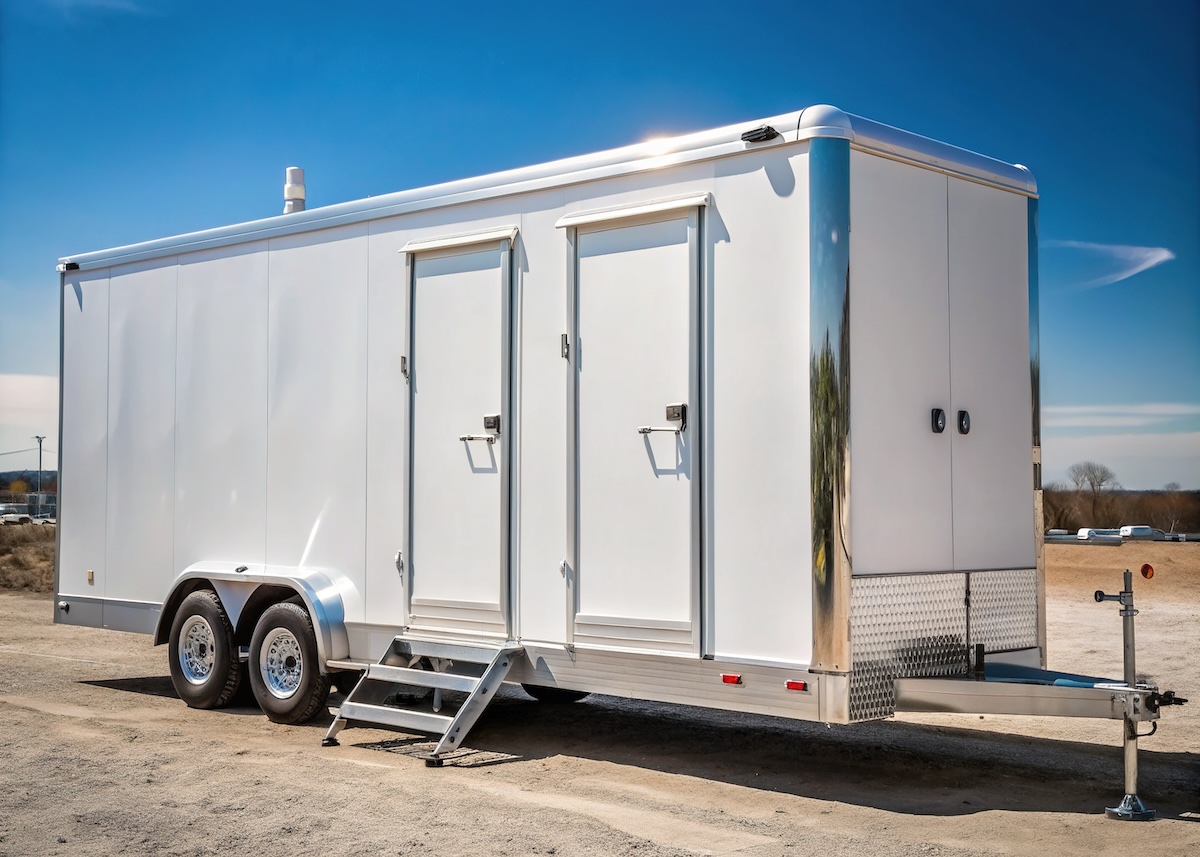
They are generally going to be notably more expensive than standard units, and are better suited to long-term projects with client-facing requirements, high-profile site visits, or projects where the owner or developer has specified a higher standard of site facilities.
Some residential builders use a restroom trailer when working on high-end homes where the client’s own experience and the crew’s comfort both warrant the upgrade.
Standalone handwashing station
Standalone handwashing stations are separate units that supply fresh water, soap, and paper towels. They are not restrooms but are typically placed alongside portable toilets because OSHA requires handwashing facilities in close proximity to toilet facilities on construction sites. Some portable toilet units include a small integrated sink; others do not. A standalone handwashing station adjacent to standard units is a clean solution that satisfies the regulatory requirement and supports good hygiene on site.
Where to place portable toilets on a job site
Placement matters more than it is often given credit for. A unit that is poorly positioned creates friction every time a worker needs to use it, and friction in that particular situation tends to have predictable outcomes: workers either leave the site to find alternatives or they stop using the facilities as frequently as they should. Neither is good.
A few principles that apply to most sites:
- Level ground: Units placed on uneven or sloped surfaces are unstable and uncomfortable to use. They are also harder to service, since the pump truck operator needs the unit upright and accessible. Find the flattest available position within a reasonable distance of the work area.
- Service truck access: The pump truck that services the unit needs to be able to pull within hose distance, typically within about 30 feet, of each unit. Placing toilets in areas the service truck cannot reach creates a problem on every service day. This is particularly relevant on sites where access is restricted by active construction, gates, or tight urban footprints.
- Away from food and water: Units should be positioned away from any area where food is prepared or stored and away from water supply lines, stormwater drainage features, and any area with a high risk of contamination in the event of a spill or tip-over.
- Wind direction and shade: Positioning units downwind of the main work and break areas reduces odor impact. Shade, where available, keeps interior temperatures lower during hot weather, which matters both for user comfort and for the rate at which the waste tank fills and odors develop. In climates with intense summer heat, shaded placement is a meaningful quality-of-life difference for the crew.
- Proximity to the work: Units should be close enough to be convenient without being so close to active work areas that they interfere with operations or create a visibility issue for clients or neighbors. On large sites, distributing units across the site reduces travel time and improves usage rates.
- Drainage and flood risk: Avoid placing units in low-lying areas or anywhere that collects standing water. A unit that tips over or floods creates a significant cleanup problem and a potential contamination event.
How often portable toilets need to be serviced
Standard portable toilet rental agreements typically include one service per week per unit. Servicing involves pumping the waste tank, cleaning and deodorizing the interior, restocking toilet paper and hand sanitizer, and checking the unit for any damage.
For a single unit used by up to around 10 workers on a standard workday schedule, weekly service may be appropriate. That said, there are several other factors that can push the requirement toward more frequent service:
- Higher crew count: A unit serving more than 10 workers consistently will fill faster. If you are at the upper end of the ratio for your unit count, twice-weekly service reduces the chance of a unit being out of commission before scheduled service day.
- Hot weather: Heat accelerates odor development and can affect the chemical compounds that control waste breakdown. In climates with sustained high temperatures, more frequent service keeps the experience tolerable for workers and maintains a professional appearance for the site.
- Extended daily hours: Projects running long days or multiple shifts use restroom facilities more intensively than a standard 8-hour workday schedule. Adjust service frequency accordingly.
- Visitor access: If clients, inspectors, or other visitors will be using the facilities, the standard for cleanliness warrants more frequent attention. A unit that is overdue for service reflects on the professionalism of the operation more broadly.
Between scheduled service visits, keeping a basic supply of toilet paper and hand sanitizer on hand allows for restocking when the unit runs low. Informing the rental company promptly if a unit is damaged, tipped, or filling faster than expected allows for an unscheduled service before the situation becomes a problem.
Portable toilets on residential construction sites
Residential construction has its own set of considerations that commercial sites do not always share. When a crew is working on or adjacent to someone’s home, the dynamic around restroom access is different in a few important ways.

The most common situation is a remodel, addition, or new build on an occupied property. In those cases, asking workers to use the client’s household bathroom creates genuine problems. Workers cycling through a client’s home for restroom breaks disrupts their routine, reduces privacy on both sides, and introduces a steady traffic pattern into the living space. Clients who are home during construction often find this uncomfortable, and workers are put in the awkward position of navigating personal spaces that are not their own. A portable toilet on site resolves this cleanly for everyone.
Placement is worth more thought on residential sites because visibility matters. A unit positioned in the front yard or directly visible from the home’s primary living areas is more obtrusive than one tucked to the side or rear of the property, out of the main sightlines from windows and the street. On tight lots, this requires some thought during setup, but it is worth the effort. Clients who see a well-placed, maintained unit tend to view it as evidence of a professional operation. Clients who see the opposite notice that too.
On HOA and permit requirements: Some homeowners associations and local municipalities have regulations about portable toilet placement in residential neighborhoods, including restrictions on street-facing visibility, required screening, or time limits on how long a unit can remain at a property. It is worth checking local requirements or asking the client whether the HOA has any relevant rules before placing a unit.
Handwashing stations: what the rules require
OSHA’s sanitation standard requires that toilet facilities be accompanied by handwashing facilities. The standard specifies that these facilities be in close proximity to the toilet units and that they supply potable water, soap, and single-use towels or an air dryer.
The hand sanitizer dispenser inside a standard portable toilet unit partially addresses this requirement, but standalone handwashing stations are the cleaner compliance solution and the better hygiene outcome. Workers who have access to running water and soap for handwashing after restroom use are more likely to wash their hands thoroughly than those relying on a sanitizer dispenser in a confined space.
On food-handling or food-adjacent sites, handwashing station access takes on additional regulatory significance. For general construction, the primary driver is OSHA compliance and worker hygiene, both of which are well-served by placing at least one standalone station alongside your toilet units.
Portable toilets and worker productivity
The productivity case for adequate on-site restroom facilities is worth making explicitly because it sometimes gets overlooked when project managers are calculating costs.
A worker who leaves the site to find a restroom at a nearby gas station, restaurant, or retail store loses time on every trip. The round trip, including walking or driving to the location, waiting, and returning, can add up to 15 to 20 minutes depending on proximity. For a crew of 10 workers, each taking one off-site trip per day, that represents meaningful cumulative time over the course of a project.

On-site facilities eliminate that loss entirely. Workers who do not have to leave the site stay on task, and the resulting time on site during working hours is recovered for productive work. The rental cost of a portable toilet on a typical project is a fraction of what the recovered labor time is worth.
There is also a less quantifiable but real effect on crew morale and perception. A site that provides clean, adequate restroom facilities communicates that the people running the job have thought about the working conditions of their crew. That kind of attention to crew welfare tends to be noticed and appreciated, particularly on longer projects where the relationship between a crew and its management matters for retention and effort.
Environmental considerations
Portable toilets use a fraction of the water that a conventional flushing toilet does. A standard flush toilet uses between 1.28 and 1.6 gallons of water per flush under current federal efficiency standards, and older models use considerably more. A standard portable toilet uses no water at all for waste handling, relying instead on a chemical solution in the holding tank. Flushable units use a small amount of water per flush but still operate at a fraction of the consumption of a conventional toilet connected to a water line.
Waste collected in portable toilet holding tanks is pumped out by certified service providers and transported to licensed wastewater treatment facilities for proper processing. This is a controlled, regulated disposal process. By comparison, a worker leaving a site to use a distant facility is an unmonitored variable.
For projects pursuing environmental certifications or operating under environmental management plans, portable toilet use can be documented as part of the site’s waste management and resource conservation record. Your rental provider can typically supply service records for this purpose.
Frequently asked questions (FAQ)
How far should a portable toilet be from the work area?
Close enough that workers will use it. OSHA does not specify an exact distance, but industry guidance and common sense suggest units should be within reasonable walking distance of the primary work area, generally no more than a few hundred feet. On large sites, distributing units across zones keeps any given worker from having to walk a significant distance.
Can a portable toilet be placed on concrete or asphalt?
Yes, and these are often preferable surfaces because they are level, stable, and unlikely to shift under the weight of the unit or the service truck. The main consideration is whether the service truck can access the location without damaging the surface or becoming obstructed. If the unit will be placed in a finished area, check with the rental company about any requirements for protective matting or base placement.
What happens if a portable toilet tips over on a construction site?
Contact your rental company immediately. A tipped unit should not be righted by site crew; the rental company has the equipment and protocols to handle the situation safely and to clean up any waste that has spilled. Preventing tip-overs is worth addressing proactively: ensure units are on level ground, avoid placement in high-wind exposure areas, and do not allow vehicles or heavy equipment to operate in close proximity to the units.
How long can a portable toilet rental last?
Portable toilet rental agreements are flexible. Short-term rentals for projects lasting a few days are common. Longer-term agreements covering months of continuous construction are equally standard. Most rental companies offer both options, and it is typically possible to adjust the rental period if the project timeline changes. Weekly servicing is usually included regardless of rental duration.
Are portable toilets required on a construction site with only 1 or 2 workers?
Yes. Under OSHA’s standard, one toilet is required for sites with 1 to 15 workers. There is a specific exception: when the work is performed within a short distance of toilet facilities the workers are permitted to use and that meet OSHA standards, the on-site requirement may be satisfied.
The practical interpretation of this exception is narrow and applies in situations where workers have immediate access to compliant facilities, not simply a nearby business that has a customer restroom. When in doubt, having a portable unit on site is generally the better answer.
What should I look for when choosing a portable toilet rental company?
Reliability of service is the most important factor. A rental company that services units on time, shows up when scheduled, and responds promptly when you call with an issue makes the whole arrangement work smoothly. A company that misses service days or is difficult to reach when something needs attention creates headaches that can be avoided by asking about service reliability before signing an agreement.
Beyond reliability, look for fair pricing that covers delivery, pickup, and the agreed service frequency without hidden fees. If you need ADA-accessible units, luxury portable restroom trailers, or specialized equipment, confirm availability before committing. And if you are managing a project that requires documentation, ask whether the company provides service records.
How do I keep a portable toilet clean between service visits?
The rental company handles the deep clean and pump-out on service day. Between visits, a few simple steps help maintain the unit. Keep a spare roll of toilet paper and a bottle of hand sanitizer nearby so the unit can be restocked when it runs low without waiting for the next service. Let your crew know to report any damage, vandalism, or issues with the lock or door hinge promptly so they can be addressed. Some project managers do a quick visual check of their units daily, which takes about 30 seconds and catches small issues before they become larger ones.
Getting the setup right from day one
The decisions that matter most for portable toilet setup on a construction site are also the ones most worth making before the project starts rather than after: how many units you need, which types suit your site conditions and workforce, where they go, and how often they need to be serviced. Getting those details right at the outset means the facilities just work, and the crew, the client, and the inspector never have cause to think about them.
A good portable toilet rental company will help you think through those decisions based on your specific project. Hopefully, the information we’ve gone over above gives you a solid foundation to start that conversation.
If you’re in the greater Colorado Springs area or Seneca, SC/Upstate South Carolina area, click here to contact MCS Portable Restrooms.