

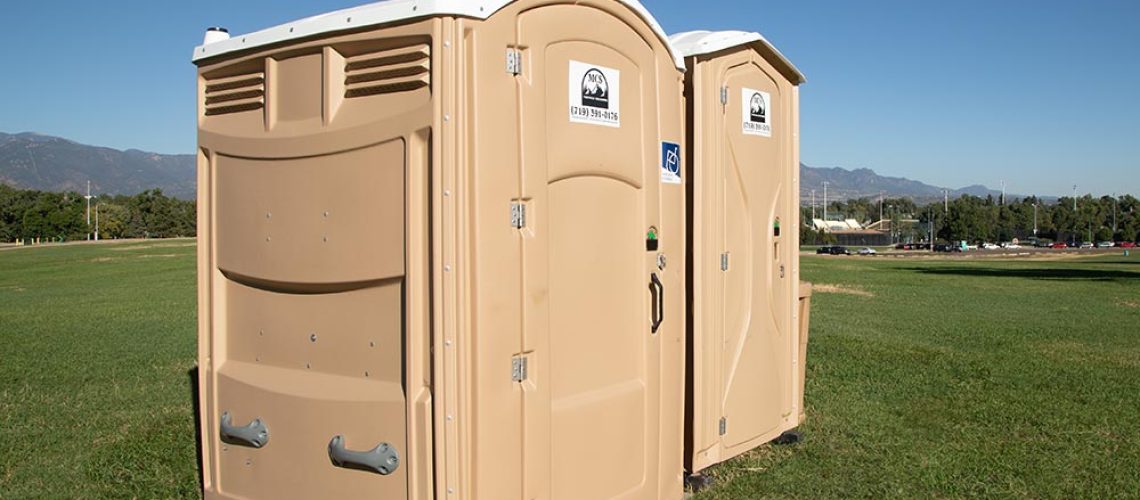
An ADA accessible portable restroom is a single-user unit built with the interior turning space, door width, grab bars and entry that a person using a wheelchair or other mobility device needs. MCS Portable Restrooms rents accessible portable restroom rental along with standard portable toilets, luxury trailer-style units, and hand wash stations for events, public sites and projects in the Colorado Springs area and Upstate South Carolina.
The federal requirements for these units come from the 2010 ADA Standards for Accessible Design, which apply to temporary facilities as well as permanent buildings.1 The standards set how many accessible units a group of portable toilets needs, what goes inside each unit, and how guests reach the door. Local event rules can call for more accessible units than the federal minimum, and the City of Colorado Springs does this for events held on City property.
What Makes a Portable Restroom ADA Accessible?
Under the 2010 ADA Standards, an accessible portable toilet unit has to meet the same toilet room requirements that apply inside a permanent building, including clear floor space at the toilet, turning space and grab bars.2 The turning space requirement means the interior has to fit a 60-inch circle or an equivalent T-shaped area, which shapes the overall size of an accessible unit.
The standards give exact measurements for each of these features. The table below lists the ones that shape a portable unit most directly, along with the section of the 2010 ADA Standards where each one appears.1 Section numbers make it easier to look up the full text on the U.S. Access Board website.
| Feature | Requirement | Section |
|---|---|---|
| Turning space | A 60-inch diameter circle, or a T-shaped space within a 60-inch square with arms and base at least 36 inches wide | 304.3, 603.2.1 |
| Door opening | At least 32 inches of clear width | 404.2.3 |
| Toilet seat height | 17 to 19 inches above the floor, measured to the top of the seat | 604.4 |
| Grab bar locations | On the side wall closest to the toilet and on the rear wall | 604.5 |
| Grab bar height | 33 to 36 inches above the floor, measured to the top of the gripping surface | 609.4 |
| Identification | The International Symbol of Accessibility on each accessible unit, unless every unit in the group is accessible | 213.2, 216.8 |
Features of ADA Accessible Portable Restroom Units
MCS describes its ADA units as wheelchair accessible, with a flat-floor design for wheelchair access and maneuvering inside. The units can also serve as a family-sized restroom. The features MCS lists for its ADA portable restrooms include:
- Large, mechanically assisted doors
- A flat floor designed to accommodate most mobility assistance devices
- Specially designed handrails
- Large, easy-to-grasp handles, rotary latches and paper holders designed for ease of use
- Extra room to accommodate families
- Durable construction that stands up to outdoor conditions
MCS rents its ADA units alongside standard portable restrooms and hand wash stations. The portable restroom rentals page describes the standard and ADA units side by side, including the large holding tanks and ventilation design of the standard models.
How Many ADA Portable Restrooms an Event Needs
When several single-user portable toilets are grouped at one location, the ADA Standards require at least 5 percent of the units in each group to be accessible.1 The standards call each group a cluster, and an advisory note in the standards describes a cluster as units that sit close together, generally within sight of or next to one another. An event with restroom stations at the entrance and at the far end of a field has two clusters, and each one is counted separately.
Fractions round up. Section 104.2 of the standards says that when a percentage leaves a remainder, the next whole number applies, so a cluster of up to 20 units needs at least one accessible unit and a cluster of 21 to 40 units needs two.1 Accessible units in a mixed cluster are marked with the International Symbol of Accessibility, the familiar wheelchair symbol. The symbol isn’t required when every unit in the cluster is accessible.
Colorado Springs Events on City Property
The City of Colorado Springs publishes an ADA addendum for special events held on City property, which includes City parks, City facilities and public rights-of-way. The 2024 version of that addendum sets a higher figure than the federal standards: at least 10 percent of portable toilets must be accessible, never fewer than one, with at least one accessible unit in every cluster.4
The same addendum asks for each accessible unit to sit on an accessible route with its door facing that route, and it recommends two portable toilets for every 250 people at peak attendance. It lists the City’s Office of Accessibility as the contact for questions about vendors and unit placement.4 The table shows how the federal and City figures compare for a single cluster.
| Units in one cluster | 2010 ADA Standards (5 percent) | Colorado Springs City property (10 percent) |
|---|---|---|
| 8 units | 1 accessible | 1 accessible |
| 20 units | 1 accessible | 2 accessible |
| 30 units | 2 accessible | 3 accessible |
| 40 units | 2 accessible | 4 accessible |
| 60 units | 3 accessible | 6 accessible |
Total unit counts depend on guest numbers and event length. MCS covers that side of planning in its guide to how many porta potties to rent. Where an event in Upstate South Carolina needs a city or county permit, the permit office can confirm whether a local accessibility figure applies in addition to the federal one.
Where to Place ADA Portable Restrooms
An accessible unit has to connect to the rest of the site by an accessible route, which is a continuous path that a person using a wheelchair can travel.1 The ADA National Network’s guide to temporary events adds that accessible portable toilets belong on a level area joined to that route, with enough space just outside the door for a wheelchair user to pull into position, open the door and go in.3
On outdoor sites, grass, gravel and slopes all affect how easily a wheelchair moves. The 2010 ADA Standards set these limits for walking surfaces along an accessible route, and they apply to the path leading up to each accessible unit:1
- Ground and floor surfaces that are stable, firm and slip resistant (302.1)
- A running slope, measured in the direction of travel, no steeper than 1:20, and a cross slope, measured side to side, no steeper than 1:48 (403.3)
- A clear width of at least 36 inches (403.5.1)
- Vertical changes in level of 1/4 inch or less, with changes between 1/4 inch and 1/2 inch beveled at a slope no steeper than 1:2 (303)
- A ramp for larger changes in level, with a running slope no steeper than 1:12, a rise of no more than 30 inches per run, landings at least 60 inches long at the top and bottom, and handrails on any run that rises more than 6 inches (405)
For grass fields and parks, the ADA National Network guide lists compact soil and cut grass as workable natural surfaces. It names synthetic matting, interlocking rubber tiles and perforated plastic mats as covers for less stable ground, and it describes tall grass, soft sand and loose gravel as difficult to cross.3 The guide also notes that units can sit on or next to parking lots and other paved surfaces, and that a temporary platform can create a level area on a sloped site.
The door threshold has to be accessible too. Outdoor ground is often uneven where it meets the unit, and the guide suggests a small bevel to smooth the transition from the ground to the threshold.3 In Colorado Springs, the City’s addendum for events on City property also asks for the door of each accessible unit to face the accessible route.4
Hand Wash Stations Near ADA Units
Setting hand wash stations along the same firm, level route keeps them on a path that guests using the ADA unit can travel. MCS portable hand wash stations come with water, soap and paper towels, and they are available for events and jobsites in both the Colorado Springs area and Upstate South Carolina.
ADA Portable Restrooms on Construction Sites
Construction sites have a separate rule. Section 203.2 of the ADA Standards states that portable toilet units provided for use exclusively by construction personnel are not required to meet the toilet room requirements or to sit on an accessible route.1 The exemption covers units used only by the crew, so a unit that visitors or members of the public also use can fall outside it.
OSHA’s sanitation standard for construction, 29 CFR 1926.51, still requires toilets for workers. Its table calls for one toilet for 20 or fewer employees, one toilet seat and one urinal per 40 workers for 20 or more, and one toilet seat and one urinal per 50 workers for 200 or more.5 MCS covers jobsite planning in more detail in its guide to portable toilets for construction sites.
ADA Portable Restrooms at Weddings, Festivals and Public Events
Title II of the ADA covers the services, programs and activities of state and local governments, and Title III covers businesses and nonprofits that serve the public.6 Festivals in city parks, community races, county fairs and events at venues open to the public often fall within those groups, and for those events the cluster figures above apply.
For private gatherings such as weddings, reunions and backyard parties, the guest list can guide whether to add an ADA unit. An ADA unit gives guests who use wheelchairs or walkers a restroom they can enter and turn around in. Because MCS ADA units can also serve as a family-sized restroom, the extra room can help a parent with a young child.
Festivals and fairs
Large sites often have several restroom stations. Each station is its own cluster for counting accessible units, and each accessible unit needs a route that connects it to the activity areas.
Weddings and private parties
An ADA unit placed beside standard units on a level, firm path gives guests who use mobility devices, older relatives and families with small children a unit with room to turn around inside.
Parks and public sites
Events on public land can come with permit conditions about accessible restrooms, such as the Colorado Springs addendum for events on City property.
For planning the rest of an event’s restrooms, MCS’s guide to outdoor restroom rental for events and weddings covers unit types, unit counts, placement and setup for weddings, festivals, races and other outdoor gatherings of different sizes.
Renting ADA Portable Restrooms From MCS
MCS Portable Restrooms has served the Colorado Springs area for more than 30 years and also serves Upstate South Carolina, including surrounding areas like Seneca, Anderson and Greenville. ADA compliant units are available alongside standard portable restrooms, hand wash stations and comfort stations.
A few details help when requesting ADA units: the event or project address, the dates, expected attendance, how many restroom locations the site will have, and the type of ground where the units will go.
Tip: The porta potty rental checklist covers many of the rest of the planning details, and you can ask questions or use the rental request form to get in touch with the MCS Portable Restrooms team.
ADA Portable Restroom FAQ
Q: How many ADA portable toilets does an event with 100 guests need?
A: That depends on how many restroom clusters the site has. Under the 2010 ADA Standards, each cluster of up to 20 units needs at least one accessible unit, so a single restroom station serving 100 guests needs one, and two separate stations need one each. Events on City of Colorado Springs property follow the City’s addendum, which calls for at least 10 percent of units, never fewer than one, with one in every cluster.
Q: Do ADA portable restrooms need a sign?
A: Yes, whenever a cluster mixes standard and accessible units. The accessible units carry the International Symbol of Accessibility. When every unit in a cluster is accessible, the standards don’t require the symbol.
Q: Are ADA portable restrooms required on construction sites?
A: Not for units used only by the construction crew, which Section 203.2 of the ADA Standards exempts. OSHA’s construction sanitation standard still sets the number of toilets a crew needs.
Q: Can an ADA portable restroom go on grass?
A: Short, compact grass on level ground can work. Tall grass, soft ground and slopes make the door harder to reach in a wheelchair, and the ADA National Network’s event guide mentions matting, interlocking tiles and temporary platforms for sites like these.
Q: How is an ADA portable restroom different from a standard unit?
A: Under the ADA Standards, an accessible unit needs interior room for a wheelchair to turn, a door with at least 32 inches of clear width, and grab bars beside and behind the toilet. The features MCS lists for its ADA units include a flat floor, mechanically assisted doors and rotary latches.
Q: Who can answer ADA questions about a specific event?
A: The ADA National Network’s regional ADA Centers take questions at 1-800-949-4232. For events on City of Colorado Springs property, the City’s addendum lists its Office of Accessibility as the contact for questions about vendors and unit placement.
For an event, wedding or public site in the Colorado Springs area or Upstate South Carolina, the MCS team can quote ADA accessible units along with standard portable restrooms and hand wash stations. The number of restroom locations, the ground where the units will sit and any permit conditions are useful to have on hand when calling.
Call MCS Portable Restrooms at 719-391-0176 in Colorado or 864-614-5202 in South Carolina, or send a rental request.
References
1. U.S. Access Board. 2010 ADA Standards for Accessible Design. View source
2. U.S. Access Board. Guide to the ADA Accessibility Standards, Chapter 6: Toilet Rooms. View source
3. ADA National Network. A Planning Guide for Making Temporary Events Accessible to People with Disabilities. View source
4. City of Colorado Springs, Office of Special Events. Special Events ADA and City Accessibility Requirements Addendum (2024). View source
5. Occupational Safety and Health Administration. 29 CFR 1926.51, Sanitation. View source
6. U.S. Department of Justice. Introduction to the Americans with Disabilities Act. View source
This guide summarizes published accessibility standards for general planning purposes and is not legal advice.